
What a Trempealeau County Deed Records Search Finds
Recording a deed proves an instrument was filed. It also captures the parties, the land description, and the stated transfer. It does not settle every title question on its own. The Register of Deeds links Trempealeau County's real estate records and recorded documents online. However, the full document-type list in the current index is not published. The categories below cover common deed terms. Confirm the exact label used for a specific filing with the office. Do that before relying on it.
| Deed Type | What It Does | Common Use |
|---|---|---|
| Warranty deed | Conveys the grantor’s interest with deed warranties stated in the instrument. | Common conveyance form; read the recorded terms. |
| Quitclaim deed | Transfers whatever interest the grantor holds, without a promise of title. | Often used for a change between related parties or a title cleanup. |
| Personal representative deed | Conveys estate property through a representative acting under legal authority. | Follow the probate record when authority matters. |
| Trustee deed | Shows a transfer made by a trustee in the capacity named in the deed. | Check the trust or deed terms for context. |
| Other recorded instrument | May create, assign, modify, or release an interest in land. | Mortgages, easements, releases, and liens are not deeds of sale. |
A deed conveys an ownership interest. A mortgage instead secures a debt against land. A satisfaction or release shows that the security interest has been cleared. Easements and restrictive covenants govern use or access rather than title. The Register of Deeds page also links to UCC filings. Those personal-property security records are not the same as a real-estate lien. For court judgments, check the docket as well as the land-record index.
When you review an entry, read the recording date, instrument type, party names, and complete legal description together. Do not read them one at a time. A deed filed after a parcel split may describe only part of an earlier tract. A mortgage, meanwhile, may reference the parent parcel or several lots. A familiar surname or street address alone cannot tie a filing to one present-day parcel. Ask the recorder to clarify any index reference. That reference should include the map or volume detail you need.
Whitehall Holds the County Deed Counter
The Trempealeau County Register of Deeds sits at the courthouse, 18600 Hobson Street, Whitehall, Wisconsin 54773-8614. Listed hours run 8:00 a.m. to 4:30 p.m. on weekdays, except major holidays. Call 715-538-2311 ext. 274, or extension 244 directly. The listed email is registerofdeeds@co.trempealeau.wi.us. Beyond real estate filings, the office handles forms, vital-record services, military-discharge records, and related document questions.
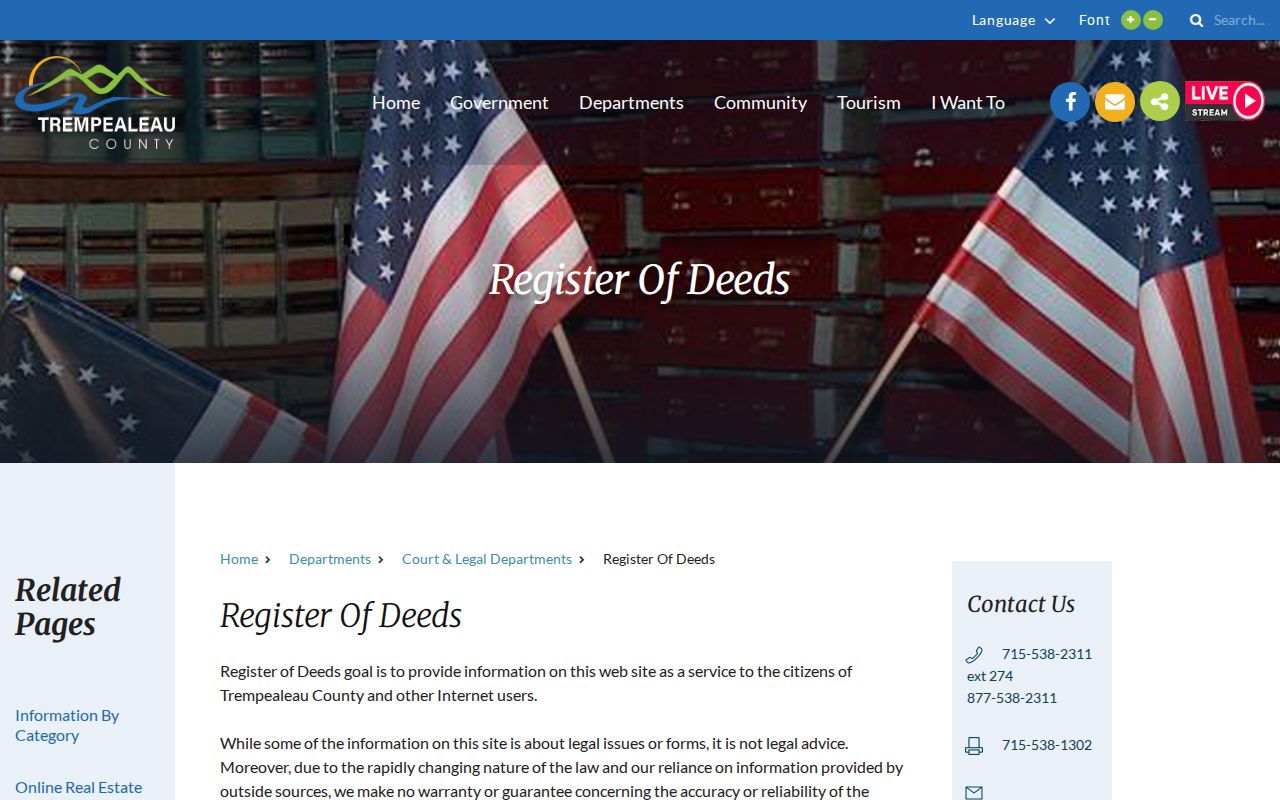
The official Register of Deeds page is the starting point for current online search links and office instructions. That page shows the office landing page rather than a grantor-grantee result, since the live index fields and image cutoff are not published there.
For an in-person request, bring names, the parcel number, a legal description, the document type, and an approximate recording period.
Follow the Trempealeau County Grantor and Grantee Names
A grantor-grantee search tracks the parties named in a conveyance. The grantor transfers an interest. The grantee receives it. Begin with the most recent deed you can identify. Read its recorded parties. Then search the prior owner as a grantee in the earlier transaction. Keep the parcel's legal description beside the names throughout. One person may own several tracts, and street labels can change over time.
- Use the parcel card to identify the current owner name and legal description.
- Locate the most recent conveyance and confirm that the grantee and land description fit the parcel.
- Read the grantor name on that deed, then find the deed by which that grantor acquired the land.
- Repeat backward, checking that each description continues to cover the same tract or explains a split.
- Grantor
- The party named as conveying an interest.
- Grantee
- The party named as receiving that interest.
- Chain of title
- The linked sequence of conveyances and related filings for a tract.
- Book and page
- A volume-and-page reference; the county’s current document reference format should be confirmed with the index.
At each earlier transfer, check the land description. It may stay identical, gain a lot number, or point to a new CSM. If it changes, the chain may need to branch into the instrument that created or conveyed the divided parcel. A grantor can also convey only a partial interest rather than the whole property. The deed's clauses and land description show what actually moved. A summary index row cannot establish that the entire tract changed hands.
Older Trempealeau County Mortgage Books at the ARC
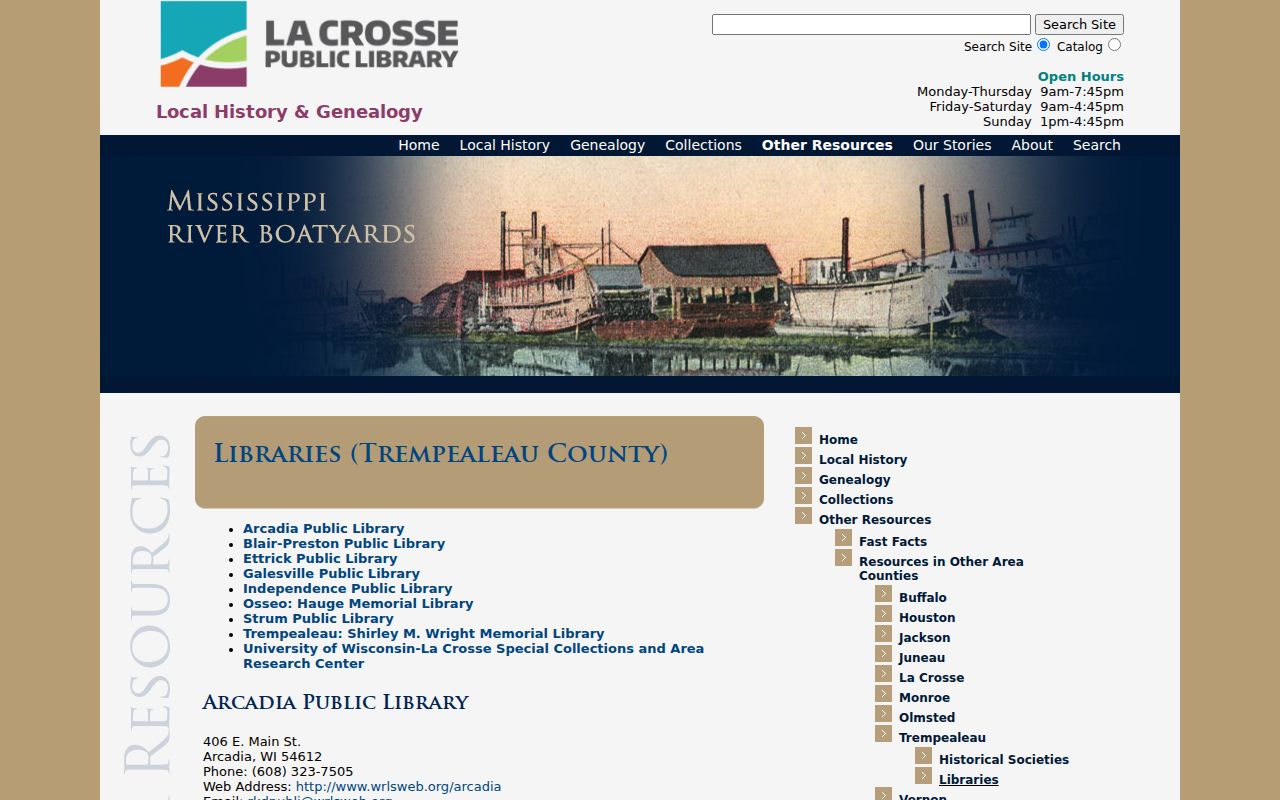
UW-La Crosse's Area Research Center lists Trempealeau County Register of Deeds mortgage records. The dates run from 1855 through 1884. These books add context when a modern online search stops short. They also help when a deed chain includes an old debt instrument. They are mortgage records, though, not a complete deed-index run. Do not treat them as a substitute for conveyances. And do not assume every year is represented the same way.
The ARC also lists intermittent tax rolls from 1856 to 1930. Its holdings include probate files through 1985, early court material, and plat books or maps from 1877 and 1901 onward. Search the collection description by record type and date before requesting a visit or copy. The ARC holdings page sets out these series.
For a chain that reaches the nineteenth century, pair each archive lead with a deed description. Include the county location as well.
Archive ranges matter when a modern index stops short of a predecessor's transaction. The ARC lists mortgage volumes only through 1884. It holds probate material through 1985. Identify the record series before planning a search. An old mortgage entry may explain a lien or a lender. But a deed or probate conveyance is what documents ownership. Keep both the instrument date and the county or township named in the description.
Deeds Before County Formation Need a Wider Search
Trempealeau County was organized in 1854. Its land once sat under Buffalo and Jackson Counties, so an old parcel history may live in a predecessor's deed records. George Gale played a role in formation, according to the county historical society. Early communities clustered along river routes and trading activity. That history hints where to ask. It does not prove which book holds your parcel.
Start with the oldest recorded deed you can find. Copy its full legal description. Then ask the Register of Deeds whether older volume references point to an earlier county or land record series. The Wisconsin Historical Society and UW–La Crosse collections add historic plat and community context. A city directory or newspaper may reveal a former street name. Neither can supply the legal link between successive owners of record.
Request a Trempealeau County Deed Copy
The Register of Deeds page links to the online real-estate search and recorded-document resources. The office publishes no confirmed image range or certified-copy fee there. Confirm those details before ordering. Phone and email both work. A written request can name the parcel, parties, recording period, and instrument sought. If the portal shows an index entry without an image, ask whether an image exists. Staff can also pull the paper volume.
Keep the request narrow. Include the parcel number and complete legal description. Add grantor and grantee if known. Include the approximate date, document type, return contact, and whether certification is needed. Ask about payment handling and whether the copy comes electronically or by mail. The counter serves visitors during posted weekday hours. Assume no fixed response time or fee from general public information.
Recorded, not guaranteed. The deed index shows filed instruments and does not certify clear title or rule out unrecorded interests. A full title review calls for a qualified title professional.
Separate a Conveyance from a Mortgage Release
A property file can hold many instruments that never change the owner of record. A mortgage records a secured loan. An assignment moves the lender's interest. A satisfaction or release marks a cleared lien. Easements, covenants, and judgments affect land use or title without conveying the parcel. Read the document type and legal description before treating an index result as a sale.
The County Register of Deeds page links real estate records, recorded documents, UCC filings, and eRecording information. Dropdown labels and index categories change, so ask the office when an instrument appears under an unexpected name. Ask, too, when a mortgage shows no visible release. A foreclosure claim may also surface in WCCA. Check that with the Clerk of Court, since a docket alone is not a recorded deed.
Use the County's Fraud Alert for New Filings
The Register of Deeds website links a Property Fraud Alert service. Signup happens through the official county page, where you can confirm the monitored-name fields and alert terms. An alert helps a subscriber notice a filing under a watched name. It does not judge validity. Nor does it decide whether a title issue exists.
Watch for unsolicited deed-copy offers. A private mailer quoting a fee is not the county's rate, and the Register of Deeds sets the official copy charge. Verify any quote with the county before sending money. Keep the letter. Confirm the recording number through the custodian. That route beats trusting a document image or payment link from an unknown sender.