
Trace Former Owners Through Separate Record Series
Ownership history is not one continuous online timeline. The Register of Deeds handles current real-estate links for Trempealeau County. Its index range and image cutoff are unstated. UW–La Crosse's ARC lists several historic record series, each with a different scope. Begin with the latest known deed, then use the tract's full description to learn which archive or predecessor county holds the next clue.
| Source | Years It Covers | Where Held | What It Shows |
|---|---|---|---|
| Register of Deeds index | Online coverage range not stated | Whitehall office and county real-estate links | Recorded conveyances and related land instruments. |
| Mortgage books | 1855-1884 | UW–La Crosse Area Research Center | Historic mortgage records; not a complete deed chain. |
| Plat maps and books | 1877; 1901-present | UW–La Crosse ARC and recorded county map sources | Historic map context and lot references. |
| Tax rolls | 1856-1930, intermittent | UW–La Crosse Area Research Center | Historic annual or available parcel-owner context. |
Recent transfers start in the Register of Deeds index. Verify the full instrument once you locate the entry. For a nineteenth-century question, ask the office whether deed books or microfilm cover your date. Then search the ARC guide for mortgage, tax, probate, and plat records. Each ARC series has its own scope, and a mortgage may show a lien without naming who acquired the land. Keep a research log with the date, party, description, and source so similar Trempealeau County names never merge into one chain.
Older Trempealeau County Mortgages at UW–La Crosse
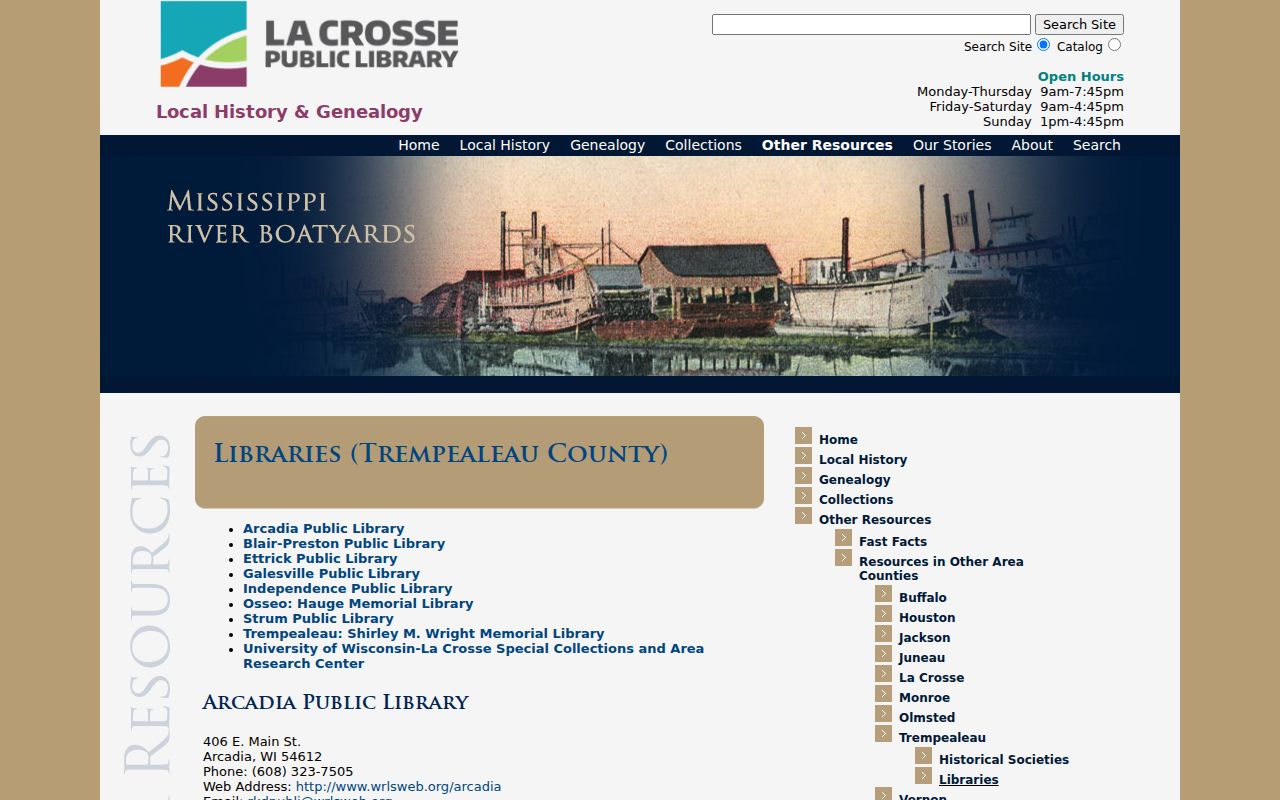
The ARC mortgage records span 1855 through 1884. That range is unusually useful for rural property history. A mortgage is not a deed. Its parties and land description can still tie a borrower or lender to a Trempealeau County tract. A later release may show when the debt ended. Treat each entry as a lead, and look for a conveyance linking the same legal description to an owner.
The collection guide also lists probate files from 1855 through 1985. Intermittent tax rolls cover 1856 through 1930, and plat books and maps date from 1877 and 1901 onward. The UW–La Crosse ARC description is the place to confirm access and series detail before a visit.
Its dates match names to the right record class.
Walk the Trempealeau County Chain Backward
Read the latest deed from the grantee's side. Then turn the grantor into your next search. Repeat that step with each prior deed, comparing the land description at every stage of the chain. Chains branch when a Trempealeau County parcel splits, merges, passes through an estate, or hides under an abbreviated description. Names alone will mislead you. Every deed must connect to the same land or explain how its boundaries changed.
- Start from the parcel’s current legal description and locate its latest recorded conveyance.
- Record the grantee, grantor, instrument date, recording reference, and exact description.
- Search the grantor as a prior grantee and compare the earlier deed’s land description.
- Repeat until the online index ends, then ask the Register of Deeds about paper books or microfilm.
- Grantor
- The party that conveys the interest.
- Grantee
- The party that receives the interest.
- Chain of title
- The connected conveyances and related filings for the same land.
- Legal description
- The land text used to identify a parcel; it can be more stable than a street address.
Before 1854, Search Beyond This County
Trempealeau County dates to 1854. Its land came from Buffalo and Jackson Counties. A chain that predates county formation may cross into predecessor-county deed books. The county historical society credits George Gale with a role in forming the county. Even so, a property search needs the deed description and location to learn which earlier books apply.
Start at the earliest known conveyance. Ask the Register of Deeds whether the cited volume predates local recording. Then turn to the ARC collections and Wisconsin Historical Society records for county, town, or community material fitting the tract. No courthouse fire or lost-record event is on record. Treat any gap as a coverage question.
For a pre-1854 clue, note whether the deed names Buffalo County, Jackson County, a township, or a community that later joined Trempealeau County. Ask the custodian which jurisdiction held it. Later boundaries never rewrite the original filing location. A modern parcel number may not exist in those older Trempealeau County books. The legal description matters more. A named watercourse, road, or adjoining owner can tie an old entry to the present tract. That is how the chain stays honest.
A Parcel Creation Date Can Explain a Broken Chain
The county sample card shows a creation date of August 5, 2016. Its split description covers 3.080 acres tied to lot 6 in CSM volume 11. A modern parcel can be younger than the older deeds describing the same land. The map key may mark a split. The older deed may use a different acreage or a different legal description.
Compare the creation date with the CSM and deed. Then identify which parent parcel conveyed the new lot. A mismatch does not break the chain. The mismatch may reflect a surveyed division, renumbering, or an updated legal description instead. The full CSM and instrument prove the connection.
How Far the Online Trempealeau County Index Reaches
The county's online deed index publishes no start year and no image cutoff. Treat that as an open coverage question. Call or write the Register of Deeds with a parcel number, party name, and date range. Ask whether an entry is indexed online. Ask whether an image exists. Also ask which deed books or microfilm hold earlier records.
Older material sits elsewhere. The ARC offers an 1855-1884 mortgage series and intermittent 1856-1930 tax rolls. It also holds an 1877 plat map and 1901-present plat holdings. None of these guarantee a continuous deed chain. Records before 1854 may belong to Buffalo or Jackson County instead. Ask the custodian to identify the right series before treating a gap as a conclusion.
Coverage note. The online index cutoff is not stated in the research. Confirm it with the Register of Deeds; older owner clues may sit in deed books, mortgage records, tax rolls, plats, or probate files.
Probate Files Can Explain an Estate Transfer
A deed that names an estate often has a probate file behind it. The same is true for a deed naming a personal representative. That file explains the authority for the conveyance. UW–La Cudge lists Trempealeau County probate files covering 1855 through 1985. Modern case dockets are searchable through WCCA. The Clerk of Court or Register in Probate hands over the actual court file. A docket entry is only a lead. The order or recorded deed carries the land detail.
Estate and trust names may be indexed differently from an individual owner of record. Keep the name exactly as written. Note the representative capacity and compare the property description against the parcel. Death records are separate vital records with their own access rules. Some death certificates less than 50 years old carry restrictions. Never infer a transfer from a death notice or parcel card alone.
To pull a modern case, use the WCCA docket to learn the court and case number. Then request the underlying file from the Register in Probate. Ask for any order that authorized a land transfer. Match that authority to the deed recorded for the parcel. Probate explains a representative's role. But the recorded deed ties the estate action to the exact land in Trempealeau County property records.
Ask Whitehall for an Older Owner Record
The Register of Deeds sits at the courthouse in Whitehall. The office is open weekdays from 8:00 a.m. to 4:30 p.m. The main line is 715-538-2311 ext. 274, with direct extension 244, and email goes to registerofdeeds@co.trempealeau.wi.us. Ask which index, volume, or microfilm run covers your year before visiting. The county does not post current copy fees or image limits. Request those details directly.
An ARC request should include the record series, county, and date range. It should also list owner names and the legal description. The deed records page explains copy requests for a single instrument. Former-owner work is about linking instruments into a chain. A county counter, an archive catalog, and a local history source each add evidence. Each adds a different kind. The Register of Deeds office page is the county's current contact point.
Check the office's current instructions to confirm deed-book coverage and copy options for an older transfer.