
Follow the Trempealeau County Owner-Finding Route
Begin with the county Real Estate Search when you have a street address. Enter what you know and read the owner rows on the parcel result. No parcel number? Try the owner-name fields. You can also use the address pieces in the legacy interface as a way to discover it. Write down the parcel number and the legal municipality before moving on. The final step is the Register of Deeds. There the most recent transfer is confirmed in the recorded deed. One caution applies. The legacy card itself warns that its ownership data may lag behind the newest recorded document. So a county card is a convenience rather than the last word.
- Search the address or owner name and identify the matching parcel and municipality.
- Read the owner row, situs address, alternate parcel, PLS location, and legal description as separate fields.
- Check the latest recorded deed for the grantee and confirm that its description covers the parcel.
- If the grantee is an entity, use state business records as a lead to its public filing information.
A Trempealeau County Parcel Card Gives Owner Leads
The county's sample card is a good map of what one parcel result can hold. It shows current and former owner rows, parcel status, situs, acreage, creation date, PLS information, districts, and an abbreviated legal description. A single card like this can launch a deed search, a map check, or a historical question about past owners. It cannot tell you who occupies a building, and it cannot prove that a recent transfer has reached the assessor record yet. One detail in the sample is instructive. It identifies a Town of Preston parcel carrying a Blair postal address, a reminder that the town in a mailing address may differ from the legal municipality. Test any match with the parcel number and the complete legal description. The legacy sample card displays these fields together.
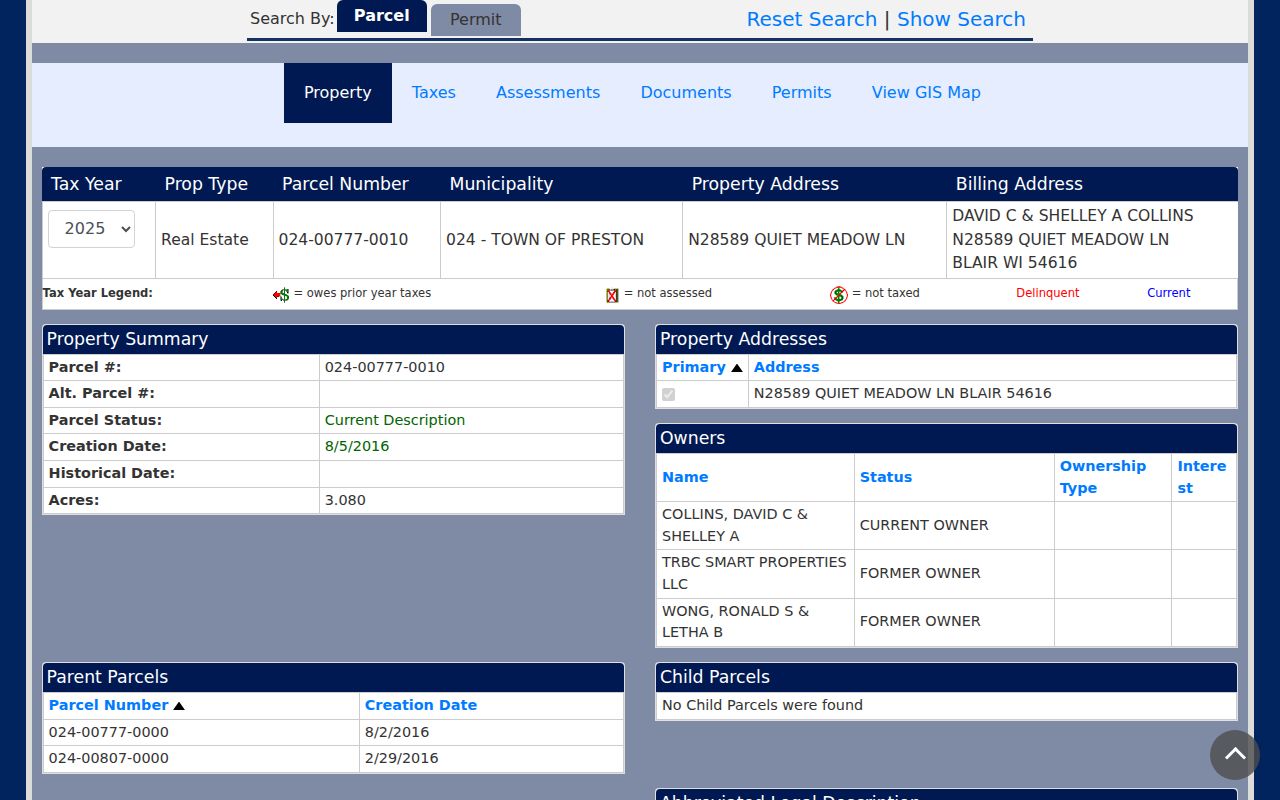
Let an owner row open the door to a deed search. Then verify both the party and the land in the recorded instrument itself. The county's sample lists a current-owner row plus former-owner entries, along with acreage, creation date, municipality, and an abbreviated land description. Those fields do real work when a street number is missing. The search then has to run on something other than an address. Keep the Blair situs label and the Town of Preston municipality as separate facts in your notes. A county result can point toward a person or an entity. Still, it cannot show who occupies a home. Nor can it establish that every prior transfer appears on the same card.
Compare the Trempealeau County Ownership Sources
An owner's name may surface in several Trempealeau County records. Each one does a different job. The assessment-linked parcel result works well as a first locator. The Register of Deeds index confirms recorded conveyances. GIS supplies spatial context. State business records can surface the public filings of an entity. That entity may show up as a grantee. Start from the county search page. The legacy interface no longer receives updates, and Ascent is the current county-linked route.
| Source | Owner Info It Gives | Access |
|---|---|---|
| Real Estate Search | Parcel owner rows and parcel identifiers; freshness depends on the current system. | County Property Search page links to Ascent. |
| Register of Deeds index | Parties to a recorded transfer and the document itself. | Online links or the Whitehall office; coverage details need confirmation. |
| Wisconsin DFI | Public corporate filing details for an entity name, where the record provides them. | State business-record entry point; current fields were not verified. |
| GIS / Land Records | Map context for a parcel, with live tools and layers to confirm. | County Land Records department page is the verified entry point. |
An owner of record is simply the party named in the public parcel or deed record. The phrase says nothing about who lives there. A situs address identifies the land, while a mailing address is where tax bills and office notices may go. Wisconsin's Safe at Home program also supplies substitute addresses for qualifying participants, so a missing or alternate address is never a reason to hunt for a protected location. Use each source for the question it answers. The parcel search matches an address to an assessment-linked owner field. A recorded deed names the parties and the land description for a filed transfer. State business records may identify public filings for a company name. None of these sources hands you a full title chain or unmasks every person behind a trust or business. If the sources disagree, keep the dates and ask the relevant custodian which record controls its own index.
Ascent and the Legacy Owner Warning
The legacy Trempealeau County portal carries a warning worth reading closely. It states that ownership data may lag the most recently recorded deed. It also notes that the legacy system stopped updating in 2025. Treat any old owner row as a discovery point only. The county now links to Ascent for its Real Estate Search, but the landing page leaves open whether a public search can be completed without an account. The reliable move is to start at the county's property-search landing page. From there, follow the route it presents. The Ascent entry screen shows the current route.
When an online owner row conflicts with a recent closing, confirm the most recent deed through the Register of Deeds. Do not trust either name until then. A practical check starts with note-taking. Record when the parcel card was viewed. Preserve its parcel number and municipality, and compare those identifiers with the legal description on the newest deed. A deed may describe only a lot or part of a tract. In that case, confirm it covers the same land. Do not assume the owner name applies to every nearby parcel. Keep a copy or recording reference for the deed, because it gives you a traceable basis for resolving any difference with the assessment system.
Entity and Estate Names Need Another Source
Not every parcel owner is a person. Land in Trempealeau County often sits in an LLC, a trust, or an estate. Search the assessor's owner field exactly as shown. Then try punctuation and word-order variations. The sample parcel card lists an LLC among its former owner rows, which is why a surname search alone can miss a party tied to the parcel.
Wisconsin DFI keeps the state's corporate records. Its listing for a company may give a registered agent or a principal office. That helps identify a business filing. It does not prove the named people own the land. Estate transfers follow a different trail. WCCA and the Register in Probate may show the court authority behind a transfer, while the deed remains the record that actually conveys the parcel.
Older family transfers may need a second path through local court and archive material. UW–La Crosse's Area Research Center holds Trempealeau County probate files from 1855 through 1985. Deeds and other court records from overlapping periods are listed there too. Those files can explain how an estate handled its land. They are no substitute for the instrument recorded against the parcel, so keep the case name, approximate year, and parcel description together when you ask an archive or court custodian to pull a file.
Limits on a Trempealeau County Owner Lookup
A public record names an owner or a party to a filing, nothing more. It cannot confirm who lives there. It will not expose unrecorded claims. Beneficial owners behind an entity stay out of view as well. The county's parcel card is not a title search. So take any important ownership question to the custodian or a title professional.
Lawful use. Use owner information for property and civic research. Do not use a lookup to stalk, threaten, or harass anyone, and do not seek to defeat a protected address.
A County Fraud Alert Can Flag New Documents
Trempealeau County's Register of Deeds links a Property Fraud Alert program on its landing page. Read the signup address, monitored-name fields, and delivery terms on that official page. An alert is only a prompt. It does not validate a deed or replace reading the recorded instrument.
Save the recording reference when a notice names a document. Compare the date and legal description with the parcel. Request the actual instrument from the Register of Deeds if the alert raises a question. Enrollment does not block a filing. It cannot guarantee notice before every record is indexed. Treat the alert as one monitoring clue alongside the official public record.
The office answers faster with specifics. Give the monitored name, the approximate recording date, and the document number from the notice. The county staffs the Register of Deeds on weekdays at the Whitehall courthouse. Phone and email contact for the office appear on the official county page. Confirm signup instructions there.
An unexpected notice deserves a quick check. Match the recording details against the county's index before calling. Then call the Register of Deeds at its listed number. The county also links document and eRecording resources. Keep the parcel number, party names, and recording date together. That helps staff find the entry. Leave private address details out of the request.